


Who uses kinesiology tape?
Kinesiology taping has evolved into a widely used and accepted treatment for many people, including professional and amateur athletes. It works great for the elderly, children, and all of us everyday people too! You may think you don’t know what kinesiology tape is, but more than likely you have seen the blue, black, tan or pink strips on Olympic swimmers, volleyball players and track athletes.
In the physical therapy setting, kinesiology tape is used to assist in the treatment of many different injuries. I use it frequently on shoulders, wrists/elbows, knees, and ankles with great success. My ultimate goal is also to teach the client or family member to tape themselves. This helps them to learn to manage their pain or symptoms on their own.
Where can I find kinesiology tape?
Kinesiology tape has become available to purchase over-the-counter. It comes in 50 or more brand names! It was originally created by Kenzo Kase, a chiropractor, to influence the skin and prolong the effects of his treatments between visits. His brand of tape is called Kinesiotape or Kinesio Tex Tape.
Will the tape be hard on my skin?
Over time, kinesiology tape has been made to mimic the qualities of the skin which allows for multiple taping applications without irritating the skin. You can wear the quick-drying tape for 3-5 days, even through showers!
How do I apply kinesiology tape?
I like to teach my clients the proper way to use this product which is quickly becoming just as available as Tylenol! Clients and families are usually very interested in how to use this exciting new product, so I thought I would outline what I typically teach as “Kinesiology Taping 101.”
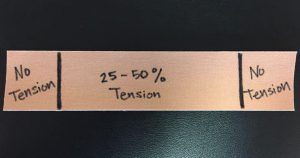
1) There should never be tension or pull on approximately one inch of either end of the tape strip when applied. All the tension is in the middle of the strip and typically the less tension (25%-50% of the maximum stretch) the better.
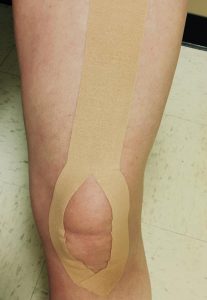
2) To assist or facilitate a weak muscle, taping is done from origin (where the muscle begins) to insertion (where the muscle attaches). This is where knowledge of human anatomy comes in, or maybe Google. 🙂 For example, pain in the front of the knee may be worsened by weakness of the quadriceps muscle group. The quads originate from the groin area and insert below the patella (knee cap). So a quadriceps taping might look like the below. It would be used to assist with treating knee pain or weakness after injury or surgery. I typically splint the tape into a “Y” to go around the knee cap rather than over.
3) To treat over-used or stretched/strained muscles, the tape is applied in the opposite direction, insertion to origin. So, for the hamstrings (back of the thigh) after a hamstring strain, the tape strip would be applied from just above the back of the knee up to the start of the glute muscle. The best position to apply this taping method would be with the injured person lying on their stomach on an elevated surface. The leg being taped should be resting off the side of the surface at a downward angle toward the floor. And remember, no tension on the ends!
4) The tape can remain on for up to 5 days even during showers. It will feel damp after a shower but will dry back to its original state.
5) When removing the tape, push down on the skin as you pull straight up on the tape to avoid injury to the skin.
6) The tape is typically latex-free but if you experience any excessive itching or redness around the area of the tape, it needs to be removed. Also, if you feel your pain is worse with the tape on, it needs to be removed.
The taping techniques are essentially endless. I like the techniques from Clinical Therapeutic Applications of the Kinesio Taping Method.
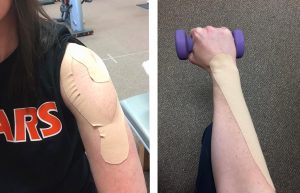
Of course YouTube videos from healthcare professionals who have been trained in kinesiology taping are also helpful. Below is a taping demonstration I did some time back with a bit different methodology than I describe above. It is for treating anterior (front of the) knee pain.
So, what is your experience with kinesiology tape? Have you tried it for that annoying knee or shoulder pain? Any success? I would love to hear from you!
